
BOARD MEETING DATE: February 3, 2006
AGENDA NO. 38
Adopt Proposed Rules 3501 – Recordkeeping for Locomotive Idling; and 3502 – Minimization of Emissions from Locomotive Idling
SYNPOSIS:
Proposed Rules 3501 and 3502 establish recordkeeping and idling requirements for diesel freight locomotives. The purpose of Proposed Rule 3501 is to record idling events to assist the AQMD in quantifying idling emissions. The purpose of Proposed Rule 3502 is to minimize emissions from continued idling of freight locomotives operating in the District. These rules will apply to Class I freight railroads and switching and terminal freight railroads that operate locomotives in the District.
COMMITTEE:
Mobile Source, March 25, 2005, November 18, 2005, and January 27, 2006, Reviewed
RECOMMENDED ACTIONS:
Adopt the attached resolution:
- Certifying the Program Environmental Assessment for Proposed Rules 3501 – Recordkeeping for Locomotive Idling; and 3502 – Minimization of Emissions from Locomotive Idling; and
- Adopting Proposed Rule 3501 – Recordkeeping for Locomotive Idling; and
- Adopting Proposed Rule 3502 – Minimization of Emissions from Locomotive Idling.
Barry R. Wallerstein, D.Env.
Executive Officer
Background
Idling locomotives are a source of noise, odors, and air pollution, particularly diesel particulate matter and oxides of nitrogen (NOx). In the past, District staff has received complaints from the public regarding idling locomotives. Comments have been made directly to the District through its complaint hotline, town hall meetings, and written comments. Between 2002 and 2005, the District received approximately 300 complaints regarding locomotives and locomotive idling. In addition, there have been reports of locomotives idling for hours as crews would leave a locomotive for a break or waiting for a replacement crew to arrive.
Locomotives idle for a variety of reasons. Some reasons for idling may be necessary for the safety or operation of the locomotive such as for safety, to provide air pressure to railcar brakes, to provide voltage to the battery to start the locomotive, to provide comfort heating and cooling for the crew, etc. However, the District staff believes that there are specific situations where locomotive idling is not necessary and that shutting off the locomotive in those situations would clearly not affect railroad operations.
Regulatory Authority
The authority to regulate air pollution in California is divided between the California Air Resources Board and the local and regional air pollution control districts. Under state law “local and regional authorities”1 have the primary responsibility for control of air pollution from all sources, other than emissions from motor vehicles. The control of emissions from motor vehicles, except as otherwise provided in this division, shall be the responsibility of the State board.” (Health & Safety Code §40000). Locomotives are not motor vehicles. The law defines “motor vehicle” as “a vehicle that is self-propelled.” (Veh. Code §415(a)). A “vehicle” is “a device by which any person or property may be propelled, moved, or drawn upon a highway, excepting a device moved exclusively by human power or used exclusively upon stationary rails or tracks.” (Veh. Code §670). Because they do not operate on the highway and because they operate on stationary tracks, locomotives are not “vehicles.” Since they are not motor vehicles, they are under the jurisdiction of the districts. (Health & Safety Code §40000) CARB was also granted authority to regulate locomotives by Health & Safety Code §43013(b), as amended in 1988. However, even after the enactment of this statute, the districts retain concurrent authority to regulate nonvehicular sources, including locomotives. (Manaster & Selmi, California Environmental Law and Land Use Practice, §41.06 (2)).
The railroads have raised arguments that these rules may be preempted by the Clean Air Act or the Interstate Commerce Commission Termination Act (ICCTA). AQMD staff has addressed these concerns in the body of the staff report as well as in responses to comments. In brief, AQMD staff believes that the rules are not preempted by the Clean Air Act because they do not specify the design or construction of the locomotive; and the rules are not preempted by ICCTA because they do not interfere with rail operations. The rules are designed so that the railroads have alternative methods of compliance and can select the method most convenient for them. Also, the idling rule is designed to only limit idling in situations where idling is not necessary for rail operations.
Proposed Rules 3501 and 3502
Proposed Rules 3501 and 3502 are applicable to Class I freight railroads and switching and terminal railroads in the District. There are two Class I freight railroads that operate in the District, the Burlington Northern Santa Fe Railway Company (BNSF) and the Union Pacific Railroad (UP), and two switching and terminal railyards, Los Angeles Junction Railway (LAJ) and Pacific Harbor Line, Inc. (PHL) in the District. LAJ is wholly owned by the BNSF.
Proposed Rule 3501
Proposed Rule 3501 establishes recordkeeping requirements for idling locomotives that operate in the District. The purpose of Proposed Rule 3501 is to record idling events over 30 minutes to assist the District in both identifying opportunities for reducing idling emissions and quantifying idling emissions. Under Proposed Rule 3501, a railroad may be exempt from recordkeeping if the locomotive is equipped with an anti-idling device that limits idling to less than 15 minutes or an alternative technology (e.g., liquefied natural gas, Green Goat battery dominant hybrid system) is used. Information gathered under Proposed Rule 3501 would be used to enhance the locomotive emissions inventory and may be used to identify additional locomotive idling requirements in the future for potential amendments to Proposed Rule 3502.
Proposed Rule 3502
Proposed Rule 3502 establishes idling limits for locomotives operating in the District. The purpose of Proposed Rule 3502 is to minimize emissions from unnecessary idling of locomotives. Under Proposed Rule 3502, if a locomotive is equipped with an anti-idling device that will limit idling to 15 minutes or less; then the railroad is relieved of the idling requirements for that specific locomotive. Under the proposed rule, an unattended locomotive that is not equipped with an anti-idling device cannot idle for more than 30 minutes for the following reasons:
- Awaiting relief crews;
- Meal breaks;
- Within railyards;
- Queuing in railyards; or
- Maintenance or testing not requiring engine operation;
In addition, the proposed rule establishes idling requirements for trailing locomotives, regardless if the trailing locomotive is attended or unattended. Under Proposed Rule 3502 an operator cannot idle a trailing locomotive for more than 30 minutes if:
- Dispatcher or yardmaster notifies of delay that will exceed 30 minutes; or
- A locomotive failure or breakdown that will result in a delay of more than 30 minutes.
To ensure that idling restrictions do not interfere with railroad operations, the proposed rule provides exemptions if the locomotive is being used in an emergency, if the ambient temperature is predicted to drop below 400F in the next 24 hours where the locomotive is operated, or to maintain sufficient battery charge to restart the locomotive.
In addition, a locomotive could be exempt from idling requirements if the operator has received approval for an Emission Equivalency Plan. The objective of the Emissions Equivalency Plan is to exempt any locomotive from the idling requirements if the railroad can demonstrate that an alternative control strategy can achieve the same or greater PM and NOx emission reductions as could have been achieved through implementation of idling prohibitions.
Public Process
District staff began development of Proposed Rules 3501 and 3502 in September 2004. During the rule development process, District staff visited 14 railyards throughout the district. In addition, to facilitate communication with affected parties, a working group was formed, consisting of District staff, CARB staff, freight railroads with operations in the District, environmental groups, and community groups. The District staff met with the Proposed Railroad Working Group five times – on February 9, 2005, March 23, 3005, October 6, 2005, November 9, 2005, and December 15, 2005 (conference call with the railroads) to discuss Proposed Rules 3501 and 3502. A public workshop to present rule concepts was held on March 8, 2005. A second public workshop and California Environmental Quality Act (CEQA) scoping session for Proposed Rules 3501 and 3502 was held on October 12, 2005. Throughout the public process, stakeholders provided insight to rail operations and community issues, which are reflected in the proposed rules.
Key Issues
The District staff has received a total of four comment letters on Proposed Rules 3501 and 3502. In addition, public comment was received at the public workshops held for the proposed rules. The following key issues have been identified: (1) the need for Proposed Rules 3501 and 3502 in light of the 2005 Statewide Agreement between CARB and BNSF and UP; (2) the District’s legal authority to adopt Proposed Rules 3501 and 3502; (3) recordkeeping and reporting requirements of Proposed Rule 3501 are too burdensome; (4) Proposed Rules 3501 and 3502 should be enforceable with strict penalties; and (5) penalties collected under Proposed Rules 3501 and 3502 should be used in areas where violation occurs.
The following provides a brief summary of the key issues. The staff report for Proposed Rules 3501 and 3502 has a more detailed discussion of these issues in the responses to comments.
Need for Proposed Rules 3501 and 3502
The railroads question the need for Proposed Rules 3501 and 3502 in light of a Statewide Agreement between CARB and BNSF and UP, which the railroads believe provides all of the benefits of Proposed Rules 3501 and 3502.
The District staff believes that Proposed Rules 3501 and 3502 are needed and the requirements go beyond provisions included in the Statewide Agreement. Proposed Rule 3501 establishes recordkeeping requirements and weekly reporting of idling events, requirements that are absent in the Statewide Agreement. In addition, Proposed Rule 3502 will achieve greater emission reductions within the District by limiting non-essential idling to 30 minutes as compared to the Statewide Agreement which limits non-essential idling to 60 minutes. In addition, Proposed Rule 3502 provides clear and very limited exemptions from the idling limitations as compared to the Statewide Agreement which includes exemptions that are broad and not clearly defined.
Legal Authority
The railroads contend that Proposed Rules 3501 and 3502 are “transparent retrofit requirements” and therefore would be preempted under the federal Clean Air Act. The railroads contend that the proposed rules are so burdensome that they effectively do not give the railroads any choice but to retrofit their locomotives.
Proposed Rules 3501 and 3502 do not require retrofits or installation of any equipment on the locomotives. Instead, Proposed Rule 3501 only requires recordkeeping in order to identify opportunities for reducing idling events. Proposed Rule 3501 does allow locomotives equipped with anti-idling devices to be exempt from recordkeeping requirements since use of the anti-idling devices is expected to eliminate unnecessary idling. In that case, recordkeeping for these locomotives would not provide additional information that would assist in identifying opportunities for reducing idling events.
The objective of Proposed Rule 3502 is to minimize emissions from unnecessary idling for longer than 30 minutes. Because these idling limits are limited to situations where idling is clearly unnecessary, Proposed Rule 3502 poses no burden to railroads. Locomotives that are equipped with anti-idling devices that are set to shutdown the engine within 15 minutes will already achieve this objective. As a result, Proposed Rule 3502 would exempt locomotive with anti-idling devices from the 30 minute idling requirement.
AQMD staff disagrees that the rules are so burdensome as to effectively require the railroads to retrofit their locomotives. As discussed below, the recordkeeping and reporting requirements of Proposed Rule 3501 do no appear overly burdensome. AQMD rules commonly require daily recordkeeping, e.g. of coatings used, and railroads should be able to comply as stationary sources have. Proposed Rule 3502 is no overly burdensome because it only limits idling in circumstances where the idling is not necessary. In the CARB Statewide MOU, the railroads have identified circumstances in which idling is necessary, which do not include the cases where idling is limited by Proposed Rule 3502.
Recordkeeping and Reporting Requirements too Burdensome
The railroads believe that Proposed Rule 3501 weekly reporting requirements are too burdensome and that some alternative interval must be identified.
Proposed Rule 3501 has been modified to simplify the information that must be recorded when a locomotive idles for more than 30 minutes. In addition, the proposed rule has been revised to only require the operator to provide a reason for idling under an extreme idling event where a locomotive idles for an extended period beyond two hours. Community groups have requested that the District obtain and post weekly idling events. The District staff believes that the railroads should provide summaries of weekly idling events to inform the public as well as to identify any additional unnecessary idling patterns. Staff believes the recording of information at the time of idling can be accomplished with existing locomotive staff during their regular shift and that the weekly reporting is unlikely to take a significant amount of time.
Enforcement and Penalties
Concerns have been raised by members of the District’s Governing Board and community members that the proposed rules may not include sufficient enforcement to deter violations and ensure accurate records are maintained.
Proposed Rules 3501 and 3502 have been modified to ensure that provisions are enforceable and to specify how penalties will be assessed. To ensure railroads maintain accurate records of idling events Proposed Rule 3501 requires the railroads to maintain all information necessary to verify reported idling events for a period of at least two years. This information includes, but is not limited to, dispatch center files, locomotive operational logs, locomotive position information, and maintenance and repair records. In addition, the District staff will be committing enforcement personnel to ensure railroads are maintaining accurate records of idling events. In addition, to deter non-compliance the proposed rules have been modified to specify that penalties would be assessed based on each locomotive for each occurrence of non-compliance or each day if subject to an Alternative Compliance Plan. Finally, Proposed Rule 3502 has been modified to specifically identify circumstances in which idling is limited, because it is unnecessary, and specifically identify the circumstances of exemptions, rather than providing a catchall exemption allowing idling when it is necessary for rail operations, as in earlier versions of the rule.
Use of Penalties
Environmental and community groups believe the District should use funds from penalties to improve air quality in the communities where violations of Proposed Rules 3501 and 3502 occur.
If penalties are collected from implementation of Proposed Rules 3501 and 3502, the District staff will evaluate appropriation of these funds. The District staff will take into consideration implementation costs associated with implementing and enforcing Proposed Rules 3501 and 3502. In addition, as part of its consideration, the District staff will consider use of funds to improve air quality in local communities, specifically the areas where violations occur.
Emission Reductions
Freight rail operations, characterized primarily by activities associated with operation of diesel locomotives, are a significant source of diesel particulate matter (PM) emissions and other criteria pollutants such as oxides of nitrogen (NOx), volatile organic compounds (VOC), carbon monoxide (CO), and oxides of sulfur (SOx). The 2003 Air Quality Management Plan (AQMP) estimates freight locomotive particulate matter less than 10 microns (PM10) emissions of 0.90 tons per day, emissions of particulate matter less than 2.5 microns (PM2.5) of 0.82 tons per day, and NOx emissions of 32.98 tons per day. Diesel exhaust is listed by the California Air Resources Board (CARB) as a toxic air contaminant and has the potential to cause cancer in humans. It is conservatively estimated that in 2003 idling of freight locomotives in the District produced 0.17 tons per day of PM10 and 3.96 tons per day of NOx. Overall estimated emission reductions expected from Proposed Rule 3502 idling requirements are 0.06 and 1.35 tons per day, for PM10 and NOx, respectively.
California Environmental Quality Act
In accordance with CEQA, the District, as the Lead Agency, reviewed Proposed Rules 3501 and 3502 and prepared an Initial Study which was released for a 30-day public review and comment period from September 15, 2005 to October 14, 2005. Comments submitted on the Initial Study were responded to and included in the Draft Program Environmental Assessment (PEA) prepared pursuant to CEQA Guidelines §15168(a)(4) and §15252. No significant adverse environmental impacts were determined to be generated from implementing Proposed Rules 3501 and 3502 and, thus, the Draft PEA was circulated for a 30-day public review and comment period from December 22, 2005 to January 20, 2006. A representative of BNSF and UP informed District staff that the previously submitted comments still apply and the railroads would not submit written comments on the Draft PEA. Response to those comments can be found in Attachment K. As a result, no comment letters were received on the Draft PEA. Minor modifications were made to the Draft PEA so it is now a Final PEA.
Socioeconomic Reports
As described previously, Proposed Rules 3501 and 3502 would affect two Class I freight railroads (BNSF and UP) and two switching and terminal railroads in the district (PHL and LAJ). (LAJ is a switching and terminal railroad, wholly owned by the BNSF, and therefore, was considered as part of BNSF for this analysis.) All three affected corporations have locomotives operating within the district.
Based on the latest (July 2005) financial reports, UP had 48,000 employees with a gross revenue of $12.2 billion and BNSF had 38,000 employees with a gross revenue of $10.9 billion, respectively, in 2004. PHL had 145 employees with a gross revenue of $38 million in 2004. All these businesses are not small businesses.
Implementation of PR 3501 is expected to result in a cost impact from training personnel and recordkeeping and reporting. The total average annual cost of PR 3501 from 2006 to 2010 is projected to be $180,936. Proposed Rule 3502 prohibits unnecessary idling activities for more than 30 minutes. Implementation of PR 3502 is expected to result in a cost impact from training personnel and a potential savings associated with reducing unnecessary idling. The net impact of PR 3502 is an average annual savings of $3,219,550 from 2006 to 2010.
The implementation of PR 3501 and PR 3502 is projected to result in an average annual net savings of $3,039,054 from 2006 to 2010. The net savings from the combined two proposed rules with a 10 percent contingent cost built in would be $3,039,010. The savings will give rise to a slightly positive job impact on the overall Southern California economy.
Resource Impacts
It is anticipated that as a result of Proposed Rules 3501 and 3502, one inspector will be allocated for enforcement of these rules. Fees for Alternative Compliance Plans submitted towards compliance with Proposed Rule 3501 and Emissions Equivalency Plans submitted towards compliance with Proposed Rule 3502 will be recovered through Rule 306 plan fee provisions. Staff would consider proposals to further amend Regulation III - Fees to recover costs associated with rule implementation.
_____________________
1
The term “local or regional authority” means the governing body of any city,
county or district. Health & Safety Code §39037. “District” means an air
pollution control district or air quality management district created or
continued in existence pursuant to provisions of Part 3 (commencing with
Section 40000). Health & Safety Code §39025.
Attachments (EXE 6MB)
| A. | Summary of Proposals |
| B. | Key Issues and Responses |
| C. | Rule Development Process |
| D. | Key Contacts List |
| E. | Resolution |
| F. | Proposed Rule 3501 |
| G. | Proposed Rule 3502 |
| H. | Proposed Rule 3501 Final Staff Report |
| I. | Proposed Rule 3502 Final Staff Report |
| J. | Final Socioeconomic Report for Proposed Rule 3501 and 3502 |
| K. | Final Program Environmental Assessment for Proposed Rules 3501 and 3502 |
| L. | Errata - PR 3501 |
| M. | Errata - PR 3502 |
ATTACHMENT A
SUMMARY OF PROPOSALS
|
Proposed Rules 3501 –
Recordkeeping for Locomotive Idling; and |
|
· Proposed Rule 3501
- Record information on locomotive idling events of 30 minutes or more, starting 6 months from date of rule adoption. - For idling events of more than two hours, provide an explanation for the idling event, in addition to recording idling event information. - Retain for a period of not less than two years all information necessary to verify and substantiate idling event records. - For locomotives equipped with anti-idling devices, retain for a period of not less than two years from the date of installation, all information necessary to verify and substantiate installation of anti-idling devices.
- Submit weekly reports containing idling event information. - Submit an annual report providing current information on locomotives operating in the District.
- Locomotives equipped with anti-idling devices set at 15 minutes or less, engaged, and not tampered with are exempt from recordkeeping and weekly reporting. - Locomotives equipped to operate exclusively using an alternative technology are exempt from recordkeeping and weekly reporting. - Railroads implementing approved Alternative Compliance Plans committing to equip all locomotives in the interdistrict, intradistrict, or combined fleets with anti-idling devices or to operate on alternative technologies are exempt from recordkeeping and weekly reporting requirements. The entire applicable fleet is exempt from recordkeeping upon approval of a Plan. |
|
· Proposed Rule 3502
- Awaiting relief crews; - Meal breaks; - Within railyards; - Queuing in railyards for fueling, maintenance, or servicing; - Maintenance or testing not requiring engine operation; - Dispatcher or yardmaster notifies of delay that will exceed 30 minutes (trailing locomotives only); and - Locomotive failure or breakdown that will result in a delay of more than 30 minutes (trailing locomotives only).
- A locomotive equipped with anti-idling devices set at 15 minutes or less, engaged, and not tampered with. - A locomotive addressed under an Emissions Equivalency Plan demonstrating equivalent emission reductions as meeting idling requirements. - A locomotive being used in an emergency. - Ambient temperatures of 40oF or lower occur or are predicted in the area where the locomotive is operated. - Idling is required to maintain battery charge or voltage at a level sufficient to start the locomotive. |
ATTACHMENT B
KEY ISSUES AND RESPONSES
|
Proposed Rules 3501 –
Recordkeeping for Locomotive Idling; and |
|
Comment: The railroads question the need for Proposed Rules 3501 and 3502 in light of a statewide agreement between BNSF, UP, and CARB, which the railroads believe provides all of the benefits of Proposed Rules 3501 and 3502.
Response: The District staff believes that Proposed Rules 3501 and 3502 are needed and the requirements go beyond provisions included in the Statewide Agreement. Proposed Rule 3501 establishes recordkeeping requirements and weekly reporting of idling events, requirements that are absent in the Statewide Agreement. In addition, Proposed Rule 3502 will achieve greater emission reductions within the District by limiting non-essential idling to 30 minutes as compared to the Statewide Agreement which limits non-essential idling to 60 minutes. In addition, Proposed Rule 3502 provides clear and very limited exemptions from the idling limitations as compared to the Statewide Agreement which includes exemptions that are broad and not clearly defined.
|
|
Comment: The railroads contend that Proposed Rules 3501 and 3502 are “transparent retrofit requirements” and therefore would be preempted under the federal Clean Air Act. The railroads contend that the proposed rules are so burdensome that they effectively do not give the railroads any choice but to retrofit their locomotives.
Response: Proposed Rules 3501 and 3502 do not require retrofits or installation of any equipment on the locomotives. One objective of Proposed Rule 3501 is to identify opportunities for reducing idling events. The District staff has allowed locomotives equipped with anti-idling devices to be exempt from recordkeeping requirements since use of the anti-idling devices is expected to eliminate unnecessary idling, in which cases recordkeeping for these locomotives would not provide additional information that would assist in identifying opportunities for reducing idling events.
The objective of Proposed Rule 3502 is to minimize emissions from unnecessary idling. Locomotives that are equipped with anti-idling devices that are set to shutdown the engine within 15 minutes will achieve this objective. To require locomotives with anti-idling devices to adhere to the 30 minute idling requirements established under Proposed Rule 3502 would be redundant, thus, the idling requirements are specifically targeted at those locomotives not equipped with anti-idling devices.
AQMD staff disagrees that the rules are so burdensome as to effectively require the railroads to retrofit their locomotives. As discussed below, the recordkeeping and reporting requirements of Proposed Rule 3501 do no appear overly burdensome. AQMD rules commonly require daily recordkeeping, e.g. of coatings used, and railroads should be able to comply as stationary sources have. Proposed Rule 3502 is no overly burdensome because it only limits idling in circumstances where the idling is not necessary. In the CARB Statewide MOU, the railroads have identified circumstances in which idling is necessary, which do not include the cases where idling is limited by Proposed Rule 3502. |
|
Comment: The railroads believe that Proposed Rule 3501 weekly reporting requirements are too burdensome and that some alternative interval must be identified.
Response: Proposed Rule 3501 has been modified to simplify the information that must be recorded when a locomotive idles for more than 30 minutes. The District staff believes that the railroads should provide summaries of weekly idling events to inform the public as well as to identify any additional unnecessary idling patterns. Staff believes the recording of information at the time of idling can be accomplished with existing locomotive staff during their regular shift and that the weekly reporting is unlikely to take a significant amount of time.
|
|
Comment: Concerns have been raised by members of the District’s Governing Board and community members that the proposed rules may not include sufficient enforcement to deter violations and ensure accurate records are maintained.
Response: Proposed Rules 3501 and 3502 have been modified to ensure that provisions are enforceable and to specify how penalties will be assessed. To ensure railroads maintain accurate records of idling events Proposed Rule 3501 requires the railroads to maintain all information necessary to verify reported idling events for a period of at least two years. In addition, the District staff will be committing enforcement personnel to ensure railroads are maintaining accurate records of idling events. In addition, to deter non-compliance the proposed rules have been modified to specify that penalties would be assessed based on each locomotive for each occurrence of non-compliance or each day if subject to an Alternative Compliance Plan. Also, Proposed Rule 3502 has been modified to specifically identify the circumstances in which idling is limited, and to eliminate exemption language that was open to possible conflicting interpretations.
|
ATTACHMENT C
RULE DEVELOPMENT PROCESS
Proposed Rules 3501 – Recordkeeping for Locomotive Idling; and 3502 – Minimization of Emissions from Locomotive Idling
Public Workshop, Working Group and Board Committee Meetings
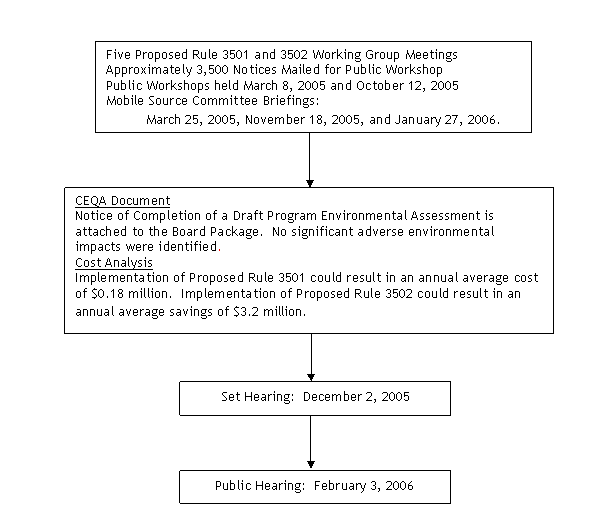
Seventeen (17) months spent in rule development.
ATTACHMENT D
KEY CONTACTS LIST
American Lung Association
Association of American Railroads
Burlington Northern Santa Fe Railway Company
California Air Resources Board
California Environmental Associates
California Environmental Rights Alliance
California Shortline Railroads
Center for Community Action and Environmental Justice
City of Los Angeles Environmental Affairs Department
Coalition for Clean Air
Communities for a Better Environment
East Yard Communities for Environmental Justice
Environmental Consultants
LA Junction Railways (BNSF)
National Railway Equipment Company
Natural Resources Defense Council
Pacific Harbor Line, Inc.
Physicians for Social Responsibility
Pillsbury Winthrop Shaw and Pittman
Union Pacific Railroad
ATTACHMENT E
RESOLUTION NO. 06-XX
A Resolution of the South Coast Air Quality Management District (AQMD) Governing Board certifying the Final Program Environmental Assessment for the Proposed Rules 3501 – Recordkeeping for Locomotive Idling and 3502 – Minimization of Emissions from Locomotive Idling
A Resolution of the Governing Board adopting Rules 3501 – Recordkeeping for Locomotive Idling and Rule 3502 – Minimization of Emissions from Locomotive Idling.
WHEREAS, the Governing Board has determined that the Proposed Rules 3501 – Recordkeeping for Locomotive Idling and Rule 3502 – Minimization of Emissions from Locomotive Idling are a “project” pursuant to the terms of the California Environmental Quality Act (CEQA); and
WHEREAS, the AQMD has had its regulatory program certified pursuant to Public Resources Code §21080.5 and has conducted CEQA review pursuant to such Program (AQMD Rule 110); and
WHEREAS, AQMD staff has prepared a Draft Program Environmental Assessment (PEA) pursuant to its certified regulatory Program and state CEQA Guidelines §15252 setting forth the potential environmental consequences of the Proposed Rules 3501 – Recordkeeping for Locomotive Idling and Rule 3502 – Minimization of Emissions from Locomotive Idling; and
WHEREAS, the Draft PEA was released for a 30-day public review and comment period from December 22, 2005 to January 20, 2005. During the 30-day public review and comment period, the AQMD did not receive any comment letters on the Draft PEA; and
WHEREAS, it is necessary that the adequacy of the Final PEA for the Proposed Rules 3501 – Recordkeeping for Locomotive Idling and Rule 3502 – Minimization of Emissions from Locomotive Idling be considered by the Governing Board prior to its adoption; and
WHEREAS, no significant adverse environmental impacts were identified from implementing the Proposed Rules 3501 – Recordkeeping for Locomotive Idling and Rule 3502 – Minimization of Emissions from Locomotive Idling and, thus, a Mitigation Monitoring Plan, pursuant to Public Resource Code §21081.6, has not been prepared since no mitigation measures are necessary; and
WHEREAS, a Statement of Findings and Statement of Overriding Consideration pursuant to state CEQA Guidelines §§15091 and 15093, respectively, has not been prepared since no significant adverse environmental impacts were identified from implementing the Proposed Rules 3501 – Recordkeeping for Locomotive Idling and Rule 3502 – Minimization of Emissions from Locomotive Idling; and
WHEREAS, the AQMD Governing Board voting on these proposed rules have reviewed, considered, and hereby certifies the Final PEA for the Proposed Rules 3501 – Recordkeeping for Locomotive Idling and Rule 3502 – Minimization of Emissions from Locomotive Idling; and
WHEREAS, the Governing Board has determined that the socioeconomic reports and staff report of the Proposed Rules 3501 – Recordkeeping for Locomotive Idling and Rule 3502 – Minimization of Emissions from Locomotive Idling is consistent with the Governing Board March 17, 1989 and October 14, 1994 resolutions and the provisions of Health and Safety Code Sections 40440.8, 40728.5 and 40920.6; and
WHEREAS, the Governing Board has reviewed and considered the staff's findings related to cost and employment impacts of Proposed Rules 3501 – Recordkeeping for Locomotive Idling and Rule 3502 – Minimization of Emissions from Locomotive Idling, as set forth in the socioeconomic reports, and hereby finds and determines that cost and employment impacts are as set forth in that assessment; and
WHEREAS, the Governing Board has determined that staff has actively considered the socioeconomic reports and made a good faith effort to minimize any socioeconomic impacts; and
WHEREAS, the Governing Board obtains its authority to adopt, amend, or repeal rules and regulations from Sections 39002, 40000, 40001, 40702, 40725 through 40728, 40910 through 40920.5, 41508, 41511, and 41700 of the California Health and Safety Code; and
WHEREAS, the Governing Board is given specific authority under §41511 of the California Health and Safety Code relative to adopting rules and regulations to require the owner or the operator of any air pollution emission sources to take such action for the determination of the amount of such emissions from such source, and prohibiting discharges from sources of air contaminants which are a nuisance or annoyance to the public or which endanger the health and safety of the public under §41700 of the California Health and Safety Code; and
WHEREAS, the Governing Board has determined that a need exists to adopt Proposed Rules 3501 – Recordkeeping for Locomotive Idling and Rule 3502 – Minimization of Emissions from Locomotive Idling to obtain information concerning idling and emissions, to reduce public health exposure to criteria pollutant and toxic air contaminants, to meet state and federal ambient air quality standards and to meet the intent of the AQMD’s Air Toxics Control Plan control measure AT-MBL-09; and
WHEREAS, the Governing Board has determined that Proposed Rules 3501 – Recordkeeping for Locomotive Idling and Rule 3502 – Minimization of Emissions from Locomotive Idling as proposed is written or displayed so that its meaning can be easily understood by the persons directly affected by the proposed rule; and
WHEREAS, the Governing Board has determined that Proposed Rules 3501 – Recordkeeping for Locomotive Idling and Rule 3502 – Minimization of Emissions from Locomotive Idling as proposed is in harmony with, and not in conflict with or contradictory to, existing federal or state statutes, court decisions, or regulations; and
WHEREAS, the Governing Board has determined that Proposed Rules 3501 – Recordkeeping for Locomotive Idling and Rule 3502 – Minimization of Emissions from Locomotive Idling as proposed does not impose the same requirements as any existing state or federal regulation and the proposed rules are necessary and proper to execute the powers and duties granted to, and imposed upon, the District; and
WHEREAS, the Governing Board has determined that Proposed Rules 3501 – Recordkeeping for Locomotive Idling and Rule 3502 – Minimization of Emissions from Locomotive Idling, as proposed, references the following statutes which the AQMD hereby implements, interprets or makes specific: H&S Code Sections 40001 (rules to achieve ambient air quality standards), 41511 (rules to gather information regarding emissions for both criteria and toxic pollutants), 41700 (prevent endangerment of public health and nuisance to public); and
WHEREAS, the Governing Board has found that there is a problem that Propose Rules 3501 – Recordkeeping for Locomotive Idling and Rule 3502 – Minimization of Emissions from Locomotive Idling will help alleviate, namely continued exceedances of state and federal ambient air quality standards, and that the rules will promote the attainment of these standards; and
WHEREAS, a public hearing has been properly noticed in accordance with the provisions of Health and Safety Code Section 40725; and
WHEREAS, the Governing Board has held a public hearing in accordance with all provisions of law; and
WHEREAS, the AQMD specifies the Manager of Rules 3501 and 3502 as the custodian of the documents or other materials which constitute the record of proceedings upon which the adoption of these proposed rules are based, which are located at the South Coast Air Quality Management District, 21865 Copley Drive, Diamond Bar, California; and
NOW, THEREFORE, BE IT RESOLVED that the Governing Board does hereby certifies the final PEA for Proposed Rules 3501 – Recordkeeping for Locomotive Idling and Rule 3502 – Minimization of Emissions from Locomotive Idling, which was completed in compliance with CEQA and Rule 110 provisions; and find that the Final PEA was presented to the Governing Board, whose members reviewed, considered, and approved the information therein prior to acting on Proposed Rules 3501 – Recordkeeping for Locomotive Idling and Rule 3502 – Minimization of Emissions from Locomotive Idling; and
BE IT FURTHER RESOLVED that because no significant adverse environmental impacts were identified as a result of implementing Proposed Rules 3501 – Recordkeeping for Locomotive Idling and Rule 3502 – Minimization of Emissions from Locomotive Idling, a Statement of Findings, a Statement of Overriding Considerations, and a Mitigation Monitoring Plan are not required; and
BE IT FURTHER RESOLVED, that the Governing Board does hereby approve the Socioeconomic Report for Proposed Rules 3501 and 3502; and
BE IT FURTHER RESOLVED, that the Governing Board does hereby adopt, pursuant to the authority granted by law, Proposed Rules 3501 – Recordkeeping for Locomotive Idling and Rule 3502 – Minimization of Emissions from Locomotive Idling, as set forth in the attached and incorporated herein by reference; and
BE IT FURTHER RESOLVED, the Governing Board hereby directs staff in considering penalties that are collected through implementation and enforcement of Proposed Rules 3501 – Recordkeeping for Locomotive Idling and 3502 – Minimization of Emissions from Locomotive Idling, after implementation and enforcement costs are considered, to consider using the remaining available penalties to improve air quality in local communities, specifically in the areas where violations occur; and
BE IT FURTHER RESOLVED, that the Governing Board hereby directs staff to develop fees as part of Regulation III amendments to recover potential costs associated with implementation of Regulation XXXV – Railroads and Railroad Operations; and
BE IT FURTHER RESOLVED, that the Governing Board hereby approves allocation of one full-time position to enforcement of District Rules 3501 and 3502.
DATE: _____________________________
_____________________________________
Clerk of the District Board
/ / /