
BOARD MEETING DATE: June 2, 2006
AGENDA NO. 33
Adopt Proposed Rule 223 – Emission Reduction Permits for Large Confined Animal Facilities.
SYNOPSIS:
The proposed rule establishes the permitting and other requirements for large confined animal facilities, as defined by California Air Resources Board (CARB), in California Health and Safety Code as a result of the enactment of Senate Bill 700. The permit for large confined animal facilities must include a plan to reduce emissions to the maximum extent feasible and the plan is to be updated annually.
COMMITTEE:
Stationary Source, March 31, 2006, Reviewed
RECOMMENDED ACTION:
Adopt the attached resolution:
- Adopting Rule 223 – Emission Reduction Permits for Large Confined Animal Facilities; and
- Certifying the Notice of Exemption (NOE) from the California Environmental Quality Act (CEQA) for Proposed Rule 223.
Barry R. Wallerstein, D.Env.
Executive Officer
Background
Senate Bill 700 was signed into law on September 22, 2003 and became effective as of January 1, 2004. One provision of the bill, codified in California Health & Safety Code Section 40724.6, requires that local air pollution control and air management districts shall, not later than July 1, 2006, adopt, implement, and submit for inclusion in the state implementation plan, a rule or regulation that requires the owner or operator of a Large Confined Animal Facility (LCAF), as defined by California Air Resources Board (CARB), to obtain a permit from the district to reduce, to the extent feasible, emissions of air contaminants from the facility. Staff has developed Proposed Rule 223 to satisfy these requirements.
Summary of Proposed Adoption
Proposed Rule 223 was developed to satisfy the requirement that all LCAFs have permits that seek to minimize their emissions. In accordance with California Health & Safety Code Section 40724.6, Proposed Rule 223 requires that the owner or operator of LCAF submit an application for a permit that includes:
- The information that the Executive Officer, or his designee, determines is necessary to prepare an emissions inventory of all regulated air pollutants emitted from the operation, including, but not limited to, precursor and fugitive emissions, using emission factors approved by CARB in a public hearing; and
- List of all equipment and the regulating District rules; and
- List of all other sources of air pollution, including but not limited to animals, birds, and lagoons; and
- Total capacity of the facility in terms of animal and bird population; and
- An emissions mitigation plan that demonstrates that the facility will use Best Available Retrofit Control Technology (BARCT) to reduce emissions of pollutants that contribute to the non-attainment of any ambient air quality standard, and that are within the District’s regulatory authority.
Proposed Rule 223 requires that all LCAFs apply for and obtain a permit that includes a mitigation plan that the LCAF will implement to reduce its emissions.
Staff believes that the above requirements in Proposed Rule 223, including the emissions mitigation plan, will further reduce emissions from LCAFs.
Under other provisions of SB 700, confined animal facilities (CAFs) under AQMD jurisdiction with annual emissions of half the major source threshold (5 tons/year) are already required to have an operating permit from the AQMD. Based on the current emission factors, LCAFs are a subset of those CAFs. Therefore, operators of LCAFs that have already applied for or have received an operating CAF permit on or before June 02, 2006, from the AQMD satisfy the information requirements of the Proposed Rule. Staff estimates that there are 55 dairies and 4 egg ranches in the AQMD that are LCAF operations.
Under Proposed Rule 223, applications to obtain a permit shall include an emissions mitigation plan to implement BARCT. The proposed rule requires compliance with BARCT but does not mandate any specific measure. District staff believes that the dust and emission control mitigation requirements in District Rules 403 – Fugitive Dust; 403.1 – Supplemental Fugitive Dust Control Requirements for Coachella Valley Sources; 1127 – Emission Reductions from Livestock Waste; and 1186 – PM10 Emissions from Paved and Unpaved Roads and Livestock Operations, satisfy most of the BARCT requirements for dairy and some portions of the poultry operations. In addition, Appendix A of Proposed Rule 223 contains a list of the Proposed Emission Mitigation Measures that staff is proposing for operators of LCAFs to implement in order to satisfy BARCT requirements, and also to mitigate other emissions. The list of control measures included in Appendix A is largely based on the control measures list originally developed by the Dairy Permitting Advisory Group, which was tasked with identifying and recommending emissions mitigation measures for the San Joaquin Valley Air Pollution Control District and was comprised of representatives from the local District, dairy industry, academia, environmental organizations, and other stakeholders. The control measures list was further refined by AQMD staff for the South Coast District in consultation with and general agreement of stakeholders, including Western United Dairymen, Milk Producers Council, Inland Empire Poultrymen, Inc. and Pacific Egg and Poultry Association. Operators of LCAFs will be required to choose mitigation measures from the list of Proposed Emission Mitigation Measures shown in the tables in Appendix A.
District staff will continue to jointly work with the stakeholders to further develop and update BARCT and other control measures for both dairy and poultry operations.
Permits that have been issued will be updated through annual renewal, in accordance with District Rule 204, to add conditions that reflect BARCT. Operators of LCAFs shall implement new or modified emission mitigation measures on a schedule approved by the Executive Officer.
In order to comply with California Health & Safety Code Section 40724.6(d)(4) noticing requirements, it is expected that permits already issued to LCAFs will be reissued and made available for public review and comments for 30 days prior to reissuance. For any, current, new or modified permit, staff will post a notice and the proposed permit on the District website and at the District headquarters for public review for 30 days. Staff will review the proposed permit with the applicant prior to posting. Based on the comments received, District staff may modify the permit, as necessary.
Issues
Although most of the issues have been addressed, the industry remains concerned about the accuracy of the currently approved emission factors. Staff will continue to work with all stakeholders in developing revisions to the emission factors, if there is new scientific evidence that would warrant such revisions. For determination of emissions fees, an operator has the alternative of demonstrating factors more representative of their emissions.
During the public notice period, staff received two additional comments. One was that the Agricultural Waste Management Field Handbook is not the proper document to use as a reference for mitigation measures. The correct document is the California Field Office Technical Guide, and the staff proposal has been revised to reflect this. This revision does not significantly change the meaning of the proposed rule nor constitute significant new information. The second comment had to do with the combination of feed and silage measures in one of the tables in Appendix A. Staff will continue to work with stakeholders to track and evaluate any new evolving scientific evidence to ensure that BARCT and BACM continue to be implemented based on the latest scientific evidence and research. An off-ramp is included in Appendix A that allows for the approval of alternate mitigation measures.
CEQA Analysis
Pursuant to the California Environmental Quality Act (CEQA), the SCAQMD is the Lead Agency and has reviewed the proposed project pursuant to CEQA Guidelines §15002 (k)(1). Because the proposed project will not require major modifications at existing facilities to comply and no daily operational emission increases are anticipated, it can been seen with certainty that there is no possibility that the proposed project in question has the potential to have a significant adverse effect on the environment. Thus, the proposed project is exempt from CEQA pursuant to CEQA Guidelines §15061(b)(3) - Review for Exemption. A Notice of Exemption has been prepared pursuant to CEQA Guidelines §15062 - Notice of Exemption. The Notice of Exemption will be filed with the county clerks of Los Angeles, Orange, Riverside and San Bernardino counties immediately following the adoption of the proposed project.
The Notice of Exemption is attached to this Board Letter.
Socioeconomic Impacts
PR 223 requires LCAF to obtain permits from the AQMD, provide emission inventory and emission mitigation plans along with their annual updates to the AQMD, and keep records of animal counts at facilities. There are 55 dairies (NAICS 112120—dairy cattle and milk production) and four egg ranches (NAICS 112310—chicken egg production) affected by the proposed rule. The 55 dairies are also subject to Rule 1127—Emission Reductions from Livestock Waste—which has requirements for dairies similar to those in PR 223. Therefore, there is no additional cost for the 55 dairies under PR 223.
Three of the four egg ranches are located in Riverside County and the remaining one is in San Bernardino County. The four ranches have already filed permits under Rule 203. Based on field visits, these ranches have been implementing control measures to mitigate potential emissions. As such, there would be no additional cost associated with control measures that would be identified in their initial emission mitigation plans.
In conclusion, PAR 223 would not result in cost impact at this time.
AQMP and Legal Mandates
The California Health and Safety Code requires the AQMD to adopt an Air Quality Management Plan (AQMP) to meet state and federal ambient air quality standards in the South Coast Air Basin. In addition, the California Health and Safety Code requires that the AQMD adopt rules and regulations that carry out the objectives of the AQMP. Furthermore, California Health & Safety Code establishes permitting requirements for LCAFs. California Health and Safety Code authorizes the AQMD to adopt a fee schedule to cover the reasonable cost of permitting, planning, enforcement and monitoring.
Resource Impacts
PR 223 requirements can be accommodated within the current staffing levels.
Attachments (EXE 358 KB)
A. Rule Development
Process
B. Key Contacts
C. Resolution
D. Rule Language
E. Staff Report
F. CEQA – Notice of Exemption
ATTACHMENT A
RULE DEVELOPMENT PROCESS
Proposed Rule 223
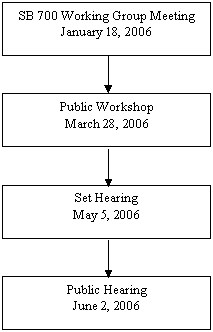
Total Time Spent in Rule Development: 6 Months
ATTACHMENT B
KEY CONTACTS
Proposed Rule 223
|
Alan Lee |
John Billheimer Enviro Reality |
Patricia Van Dam National Dairy Board |
| Alene Taber Jackson, DeMarco & Peckenpaugh |
John E. Demler Demler Egg Ranch |
Patrick Gaffney CARB |
| Amdrew Steckel U.S. EPA |
Joseph Hower Environ |
Paul Martin Western United Dairymen |
| Brent Newell Scott Bros. Dairy Farm |
Julia Lester Environ |
Paul Sousa Western United Dairymen |
| Cynthia L. Cory California Farm Bureau |
Kathy Nakase OC Farm Bureau |
Rachael R. Scott SBC Farm Bureau |
| Debbie Murdoch Pacific Egg & Poultry |
Kathy Reifkert Kallisto Greenhousess |
Steven A. Pastor Riverside County Farm Bureau |
| Don Bell UCR Cp-op Extension |
Kevin Clutter PEPA |
Tony Andreoni CARB |
| Don Brown Norco Ranch |
Laura Blank L.A. County Farm Bureau |
Will Harrison Sunrise Growers |
| Douglas R. Kuney UC Riverside Ext. |
Lucinda Roth San Joaquin Valley APCD |
William Van Dam California Milk Producers Council |
| Jim Reifkert Kallisto Greenhouses |
Nathan de Boom Milk Producers Council |
Wilma Dreessen ENSR Intl. |
ATTACHMENT C
RESOLUTION
A Resolution of the Governing Board of the South Coast Air Quality Management District (AQMD) certifying that proposed adoption of Proposed Rule 223 – Emission Reduction Permits for Large Confined Animal Facilities is exempt from the requirements of the California Environmental Quality Act (CEQA).
A Resolution of the Governing Board of the AQMD adopting Proposed Rule 223 – Emission Reduction Permits for Large Confined Animal Facilities.
WHEREAS, the AQMD staff reviewed the proposed project and determined that it is exempt from the requirements of CEQA; and
WHEREAS, the AQMD Governing Board obtains its authority to adopt, amend, or repeal rules and regulations from Sections 40000, 40506, 40510, 40702, 40725 through 40728, and 40724.6 of the California Health and Safety Code; and
WHEREAS, the AQMD Governing Board has determined that a need exists to adopt Rule 223 – Emission Reduction Permits for Large Confined Animal Facilities, to provide a permit processing rule for agricultural sources required to comply with the permit issuance requirements mandated by California Health & Safety Code Section 40724.6; and
WHEREAS, the AQMD Governing Board has determined that Proposed Rule 223 – Emission Reduction Permits for Large Confined Animal Facilities, as proposed to be adopted is written or displayed so that its meaning can be easily understood by the persons directly affected by it; and
WHEREAS, the AQMD Governing Board has determined that Proposed Rule 223 – Emission Reduction Permits for Large Confined Animal Facilities, as proposed to be adopted is in harmony with, and not in conflict with or contradictory to, existing statutes, court decisions, or state or federal regulations; and
WHEREAS, the AQMD Governing Board has determined that Proposed Rule 223 – Emission Reduction Permits for Large Confined Animal Facilities, as proposed to be adopted, does not impose the same requirements as any existing state or federal regulation and is necessary and proper to execute the power and duties granted to, and imposed upon, the AQMD; and
WHEREAS, a public hearing has been properly noticed in accordance with the provisions of Health and Safety Code Section 40725; and
WHEREAS, the AQMD Governing Board has held a public hearing in accordance with all provisions of law; and
WHEREAS, the AQMD Governing Board, in adopting this rule, references the following statutes which the AQMD hereby implements, interprets, or makes specific: Health and Safety Code Sections 39011.5, 40522, 42301, and 40724.6; and
WHEREAS, the AQMD Governing Board finds and determines, taking into consideration the factors in § (d)(4)(D) of the Governing Board Procedures, that the modifications adopted which have been made to PR 223 – Emission Reduction Permits for Large Confined Animal Facilities, since notice of public hearing was published do not significantly change the meaning of the proposed rule within the meaning of California Health & Safety Code § 40726 and would not constitute significant new information requiring recirculation of the Draft CEQA document pursuant to CEQA Guidelines § 15088.5; and
WHEREAS, the AQMD Governing Board has determined that the socioeconomic impact assessment of Proposed Rule 223 – Emission Reduction Permits for Large Confined Animal Facilities, as proposed to be adopted, is consistent with the March 17, 1989 Board Socioeconomic Resolution for rule adoption; and
WHEREAS, the AQMD Governing Board specifies the manager of Proposed Rule 223 – Emission Reduction Permits for Large Confined Animal Facilities, as proposed to be adopted, as the custodian of the documents or other material which constitute the record of proceedings upon which the adoption of this proposed rule adoption is based, which are located at the South Coast Air Quality Management District, 21865 Copley Drive, Diamond Bar, California; and
NOW, THEREFORE, BE IT RESOLVED, that the AQMD Governing Board does hereby certify the Notice of Exemption for Rule 223 – Emission Reduction Permits for Large Confined Animal Facilities, as proposed to be adopted, completed in compliance with state CEQA Guidelines Sections 15002(k)(1), 15061(b)(1), and 15273, and that it was presented to the Governing Board, whose members reviewed, considered, and approved the information therein before acting on Rule 223 as proposed to be adopted; and
BE IT FURTHER RESOLVED, that the AQMD Governing Board does hereby approve the Socioeconomic Impact Assessment; and
BE IT FURTHER RESOLVED that the AQMD Governing Board hereby directs staff to continue to work with stakeholders for further developing more accurate emission factors based on research and scientific data and to update the emission factors as and when more reliable data is available, and
BE IT FURTHER RESOLVED, that the AQMD Governing Board does hereby adopt Rule 223 – Emission Reduction Permits for Large Confined Animal Facilities, pursuant to the authority by law, as set forth in the attached and incorporated herein by this reference.
DATE: _________________________ CLERK OF THE BOARD
ATTACHMENT D
RULE LANGUAGE