
BOARD MEETING DATE: May 5, 2006
AGENDA NO. 34
Amend Rule 1132 – Further Control of VOC Emissions from High-Emitting Spray Booth Facilities
SYNOPSIS:
The Proposed Amended Rule 1132 modifies the definition of Approved Emission Factors to exclude the use of the Unified Emission Factors (UEF) rates for gel coat nonatomizing application in emissions calculations.
COMMITTEE:
Stationary Source, March 31, 2006 and April 28, 2006, Reviewed
RECOMMENDED ACTION:
Adopt the attached resolution:
- Certifying the Notice of Exemption (NOE) for Rule 1132 - Further Control of VOC Emissions from High-Emitting Spray Booth Facilities; and
- Amending Rule 1132 - Further Control of VOC Emissions from High-Emitting Spray Booth Facilities.
Barry R. Wallerstein, D.Env.
Executive Officer
Background
Proposed Amended Rule (PAR) 1132 – Further Control of VOC Emissions from High-Emitting Spray Booth Facilities was adopted on January 19, 2001, to reduce the volatile organic compounds (VOC) emissions from aerospace, metal, plastics, wood products and composite manufacturing facilities. The rule applies to spray booth facilities that emit more than 20 tons per year (tpy) of VOC and requires 65 percent emission reductions. The current proposed amendment impacts only composite manufacturing facilities.
Rule 1132 includes an Alternative Compliance Plan option for composite manufacturing facilities, defines the Unified Emission Factors (UEF) as Approved Emission Factors and allows their use to calculate emissions under the plan.
Composite manufacturing facilities are also subject to Rule 1162 - Polyester Resin Operations. Previous amendments to Rule 1162 (2001-2004) sought to reduce VOC emissions by requiring the use of nonatomizing spray application techniques of gel coats. Based on the UEF table, the nonatomizing gel coat applications represent approximately a 40 percent emissions reduction over the conventional gel coat spray application. The AQMD conducted a Gel Coat Testing Program in 2004, pursuant to an adopting resolution commitment for Rule 1162, to develop a more appropriate and enforceable definition for the nonatomizing spray application technique of gel coats. Testing also demonstrated that emission reductions from the use of nonatomizing spray equipment at levels suggested by the UEF table were not technically feasible. On July 8, 2005, the Board adopted amendments to Rule 1162 that deleted the requirement to apply gel coats solely with nonatomizing spray application techniques and deleted the UEF table.
Proposal
To maintain consistency with the Board’s determinations in the Rule 1162 process, staff proposes to disallow the use of the emission rates for the gel coat nonatomizing spray application for emissions calculations. Staff also proposes to add a new definition for composite materials and modify other definitions and rule requirements to enhance rule language accuracy, clarity and enforceability.
The proposed amendments do not affect air quality or emission limitations and do not impose any additional cost on industry.
Legislative Authority
The California Legislature created the AQMD in 1977 (The Lewis-Presley Air Quality Management Act, Health and Safety Code Section 40400 et seq.) as the agency responsible for developing and enforcing air pollution control rules and regulations in the South Coast Basin (Basin). By statute, the AQMD is required to adopt an AQMP demonstrating compliance with all state and federal ambient air quality standards for the Basin [California Health and Safety Code Section 40460(a)]. Furthermore, the AQMD must adopt rules and regulations that carry out the AQMP [California Health and Safety Code Section 40440(a)].
AQMP and Legal Mandates
The California Health and Safety Code requires the AQMD to adopt an AQMP to meet state and federal ambient air quality standards in the Basin. In addition, the California Health and Safety Code requires that the AQMD adopt rules and regulations that carry out the objectives of the AQMP. Rule 1132 originally implemented Phase I of Control Measure CTS-09 that is part of the 1999 Amendments to the 1997 Ozone State Implementation Plan for the South Coast Air Basin. This proposed amendment disallows the use of the emission factors for gel coat nonatomizing spray application in the UEF table in calculating emissions. These proposed amendments to Rule 1132 do not have any impact on air quality or emissions limitations and, therefore, have no affect on emission reductions obtained by this rule upon its adoption, and consequently do not affect the ozone attainment strategy outlined in the AQMP.
California Environmental Quality Act (CEQA) and Socioeconomic Analysis
Pursuant to CEQA and the AQMD’s Certified Regulatory Program (Rule 110), staff prepared a Notice of Exemption (NOE) for Proposed Amended Rule 1132 – Further Control of VOC Emissions from High-Emitting Spray Booth Facilities, as amended May 5, 2006. Pursuantto CEQA Guidelines §15061(b)(3), it was concluded that the proposed amendments to Rule 1132 could not have any significant adverse effect on the environment.
The proposed amendments require no changes in the composite materials, equipment or processing requirements; accordingly no socioeconomic analysis is prepared.
Attachments (EXE
479kb)
A. Summary of Proposal
B. Rule Development Process
C. Key Contacts
D. Resolution
E. Rule Language
F. Final Staff Report
G. Notice of Exemption
ATTACHMENT A
SUMMARY OF PROPOSAL
Proposed Amendments
- Change the “APPROVED EMISSION FACTORS” definition (b)(1) to exclude the nonatomizing gel coat emissions factors of the UEF table.
- Add a new definition “COMPOSITE MATERIAL” (b)(3) to include gel coat material and change definition “COMPOSITE MANUFACTURING FACILITY” (b)(4) for clarity.
- Clarify paragraph (b)(12) to read “RESIN is any thermosetting polymer…”
- Delete the allowable methods of fiberglass application, and the degree of roll-out from subparagraph (d)(1).
- Add notation in attached UEF table that the emission rates of gel coat nonatomizing application are not authorized.
ATTACHMENT B
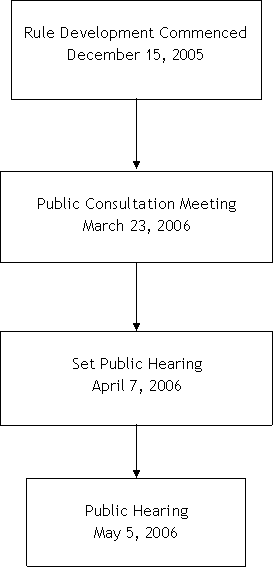
RULE DEVELOPMENT PROCESS
ATTACHMENT C
KEY CONTACT LIST
Composite Manufacturers
Gold Shield
Lasco Bathware, Inc
Industry Associations
American Composite Manufacturers Association (ACMA)
ATTACHMENT D
RESOLUTION -06
A Resolution of the Governing Board of the South Coast Air Quality Management District Certifying the Notice Of Exemption for Proposed Amended Rule 1132 – Further Control of VOC Emissions from High-Emitting Spray Booth Facilities.
A Resolution of the Governing Board of the South Coast Air Quality Management District Amending Rule 1132 – Further Control of VOC Emissions from High-Emitting Spray Booth Facilities
WHEREAS, the South Coast Air Quality Management District (AQMD) Governing Board finds and determines that the proposed amendments to Rule 1132 – Further Control of VOC Emissions from High-Emitting Spray Booth Facilities, are considered a " project" pursuant to the California Environmental Quality Act (CEQA); and
WHEREAS, the AQMD has had its regulatory program certified pursuant to Public Resources Code §21080.5 and has conducted CEQA review and analysis pursuant to such program (AQMD Rule 110); and
WHEREAS, the AQMD Governing Board has determined with certainty that the proposed amendments to Rule 1132 – Further Control of VOC Emissions from High-Emitting Spray Booth Facilities are exempt from the requirements of CEQA because there is no possibility of a significant adverse impact on the environment, and AQMD staff has prepared a Notice Of Exemption (NOE) pursuant to CEQA Guidelines §15061(b)(3); and
WHEREAS, the AQMD Governing Board has determined that a need exists to amend Rule 1132 – Further Control of VOC Emissions from High-Emitting Spray Booth Facilitiesto disallow the use of the gel coat nonatomizing emission factors of the UEF Table for calculating emissions, add definitions and other clarifying language, and
WHEREAS, the AQMD Governing Board obtains its authority to adopt, amend, or repeal rules and regulations from California Health and Safety Code §§39002, 40000, 40001, 40440, 40702, and 41508; and
WHEREAS, the AQMD Governing Board has determined that Rule 1132 – Further Control of VOC Emissions from High-Emitting Spray Booth Facilities, as proposed to be amended, is written or displayed so that its meaning can be easily understood by the persons directly affected by it; and
WHEREAS, the AQMD Governing Board has determined that Rule 1132 – Further Control of VOC Emissions from High-Emitting Spray Booth Facilities, as proposed to be amended, is in harmony with, and not in conflict with or contradictory to, existing statutes, court decisions, or state or federal regulations; and
WHEREAS, the AQMD Governing Board has determined that Rule 1132 – Further Control of VOC Emissions from High-Emitting Spray Booth Facilities, as proposed to be amended, does not impose the same requirements as any existing state or federal regulation, and the proposed amended rule is necessary and proper to execute the powers and duties granted to, and imposed upon, the District; and
WHEREAS, the AQMD Governing Board, in amending and adopting this regulation, references the following statutes which the District hereby implements, interprets, or makes specific: California Health and Safety Code §§40001(a), 40440 40702, and Federal Clean Air Act §172(c)(1); and
WHEREAS, the AQMD Governing Board has determined that there is a problem that the proposed amendments to Rule 1132 – Further Control of VOC Emissions from High-Emitting Spray Booth Facilities will alleviate; that is, maintain consistency with the Board’s determination in Rule 1162 – Polyester Resin Operations latest amendment (July 8, 2005) and discontinue the use of the emission factors of gel coat nonatomizing application of the UEF Table; and
WHEREAS, the AQMD Governing Board has determined that the proposed amendments to Rule 1132 – Further Control of VOC Emissions from High-Emitting Spray Booth Facilities do not affect air quality or emission limitations and will not result in increased costs to industry by virtue of existing material technology and existing emission controls; and
WHEREAS, the AQMD Governing Board has determined that there is no need for a socioeconomic impact assessment as this amendment has no additional cost for the composite industry; and
WHEREAS,the AQMD Governing Board has determined that Proposed Amended Rule 1132 should be adopted for the reasons contained in the staff report; and
WHEREAS, a public hearing has been properly noticed in accordance with the provisions of Health and Safety Code §40725; and
WHEREAS, the AQMD Governing Board has held a public hearing in accordance with all the provisions of law; and
WHEREAS, the AQMD specifies the Manager of Rule 1132 as the custodian of the documents or other materials which constitute the record of proceedings upon which the adoption of this proposed amendment is based, which are located at the South Coast Air Quality Management District, 21865 Copley Drive, Diamond Bar, California; and
NOW, THEREFORE BE IT RESOLVED that the AQMD Governing Board does hereby certify the Notice Of Exemption for Proposed Amended Rule 1132 – Further Control of VOC Emissions from High-Emitting Spray Booth Facilities.
BE IT FURTHER RESOLVED, that the AQMD Governing Board does hereby amend, pursuant to the authority granted by law, Rule 1132 – Further Control of VOC Emissions from High-Emitting Spray Booth Facilities, as set forth in the attached and incorporated herein by this reference.
DATE: _____________________________
CLERK OF THE BOARD