
BOARD MEETING DATE: May 5, 2006
AGENDA NO. 35
Amend Rule 1146.2 - Emissions of Oxides of Nitrogen from Large Water Heaters and Small Boilers
SYNOPSIS:
Rule 1146.2 was adopted in January 1998 to lower the emission limits for small boilers and large water heaters. The rule was amended, at the January 7, 2005 Board meeting, in order to address technical and cost issues for the retrofit of existing units. The proposed amendment will lower the emission limits of new units in order to partially offset emission reductions forgone from the extension of the compliance dates for existing units with the January 7, 2005 amendment of the rule.
COMMITTEE:
Stationary Source, January 27, 2006, Reviewed
RECOMMENDED ACTION:
Adopt the attached resolution:
- Certifying the Final Environmental Assessment (EA) for Proposed Amended Rule 1146.2 – Emissions of Oxides of Nitrogen from Large Water Heaters and Small Boilers and Process Heaters ; and,
- Amending Rule 1146.2 – Emissions of Oxides of Nitrogen from Large Water Heaters and Small Boilers.
Barry R. Wallerstein, D. Env.
Executive Officer
Background
Proposed Rule 1146.2 was originally identified as control measure CMB-06 in the 1994 Air Quality Management Plan (AQMP). The purpose of that measure was to reduce NOx emissions without increasing carbon monoxide (CO) emissions from small boilers and process heaters rated less than 2 million Btu per hour. The control measure was carried forward and included in the 1997 AQMP as control measure #97CMB-02B.
Rule 1146.2 - Emissions of Oxides of Nitrogen from Large Water Heaters and Small Boilers, was adopted in January 1998 to establish NOx and CO emission limits for new and in-use small boilers and large water heaters ranging from 75,000 Btu/hr to 2 million (MM) Btu/hr. Since rule adoption, staff has prepared and submitted to the Board three implementation studies required by the rule. A Working Group comprised of manufacturers, end-users, utilities, and other interested parties was convened to provide input and guidance to AQMD staff during each of the three implementation studies.
The purpose of the third and final implementation study (Phase III implementation study) was to evaluate the requirement for retrofit of units greater than 0.4 MM Btu/hr and less than or equal to 1 MM Btu/hr (smaller Type 2 units). The findings of the third study were presented at the July 2004 Board meeting. The Phased III study recommended modifying retrofit requirements and evaluating whether lower NOx emission limits were feasible for new equipment.
Based on the findings of the Phase III implementation study, Rule 1146.2 was amended by the AQMD Governing Board at the January 7, 2005 meeting to extend compliance dates for retrofitting in-use units greater than 400,000 Btu/hour. Under the amended rule, compliance dates for existing in-use equipment were delayed until a specific unit is 15 years old. Lower emissions limits for new equipment were not considered for the January 7, 2005 rule amendment because additional time was needed to evaluate low NOx technology and cost effectiveness.
Affected Facilities
Based on a survey conducted by the AQMD staff for rule adoption, small boilers and water heaters covered under this rule can be found in every sector of the economy. The units are used in apartment and office buildings, commercial and industrial operations such as hotels, laundering, restaurants, and a wide variety of manufacturing businesses. As part of the 1998 rule adoption, staff estimated that there were over 65,600 units in the District in the size range (75,000 to 2 MM Btu/hr) affected by this rule.
Public Process
The rule development effort for PAR 1146.2 is part of an ongoing process to assess low NOx technologies for boilers and heaters. For this rule development, staff held five working group meetings since March 1, 2005, a public workshop on October 5, 2005 and a public consultation meeting on January 17, 2006. These meetings were attended by representatives from manufacturers, trade organizations and other interested parties. At these meetings low NOx technology, Rule 1146.2 certification test results and proposed emission limits were discussed. Staff also held individual meetings with manufacturers of boilers, water heaters, burners and burner materials.
The Rule 1146.2 working group has proposed to continue to work on developing alternate compliance options which could be included in a future amendment of Rule 1146.2.
Summary of Proposal
Currently, new equipment rated more than 400,000 Btu/hour are required to meet a 30 ppm NOx limit, while smaller equipment are required to meet a 55 ppm NOx limit. The intent of Proposed Amended Rule 1146.2 (PAR 1146.2) is to lower the NOx emission limits for new equipment. Lowering the NOx emission limits are technically feasible and cost-effective. The proposed amendments will lower the NOx emissions level for most new equipment to 20 ppm or to 14 ng/Joule of heat output. Small residential pool heaters rated less than or equal to 400,000 Btu/hour would continue to meet the existing NOx limit of 55 ppm. New equipment rated greater than 400,000 Btu/hour are required to meet the 20 ppm limit by January 1, 2010. New equipment rated less than or equal to 400,000 Btu/hour must meet the 20 ppm limit by January 1, 2012. Manufacturers of both categories of equipment are required to submit progress reports two years prior to the compliance dates. PAR 1146.2 also includes more detailed requirements for demonstrating compliance with the low use exemption in the rule, clarification of rule applicability, a specific record keeping requirement for larger units and other administrative changes.
Staff received comments on the draft PAR 1146.2 and made changes to address these comments. Representatives from the Gas Appliance Manufacturers Association (GAMA) requested changes to the definitions for water heaters and several manufacturers noted that a sell through provisions should be incorporated into the rule to allow distributors to sell units that were purchased prior to the compliance date. Staff has made changes to the definitions and added a twelve month sell through period.
Emission Reductions and Cost Effectiveness
The proposed amended rule will reduce emissions from small boilers and large water heaters by a total of 1.8 tons of NOx per day. The cost effectiveness for PAR 1146.2 is estimated to be between $2,400 and $16,000 per ton. The cost effectiveness for meeting a 20 ppm NOx limit averaged $2,400 per ton for units greater than 400,000 Btu/hour (Type 2) and up to $16,000 per ton for Type 1 units less than or equal to 400,000 Btu/hr. The cost difference between meeting the current limits and the 20 ppm limit ranges from zero up to approximately $3,000 per unit.
Key Issues
District staff received many comments on the proposed rule at the public workshop, consultation meeting, and working group meetings. In addition, attendees provided letters summarizing their comments at the workshop and other meetings. From these comments, the following key issues have been identified: (1) the need for PAR 1146.2, (2) the feasibility or cost of the 20 ppm limit for smaller Type 1 units, (3) fuel efficiency, and (4) alternative compliance options. These key issues are summarized in Attachment B.
AQMP and Legal Mandates
The California Health and Safety Code requires the AQMD to adopt an Air Quality Management Plan to meet state and federal ambient air quality standards and adopt rules and regulations that carry out the objectives of the AQMP. The Health and Safety Code also requires the AQMD to implement all feasible measures to reduce air pollution. This proposed amendment of Rule 1146.2 relies on feasible technologies to further reduce NOx emissions. The NOx reductions from this proposed rule amendment will offset some of the emission reductions foregone from the January 2005 amendment of the rule, further reduce emissions by 1.8 tons per day and help achieve compliance with federal and state ambient air quality standards for ozone, PM10 and PM2.5.
California Environmental Quality Act (CEQA) Analysis
Pursuant to California Environmental Quality Act (CEQA) Guidelines §15252 and AQMD Rule 110, the AQMD has prepared an Environmental Assessment (EA) for the adoption of proposed amended Rule 1146.2. The Draft EA concludes that implementation of the proposed project would not result in significant adverse environmental impacts. The Draft EA was released for a 30-day public review and comment period and no comment letters were received. The Final EA has been prepared and is included as an attachment to this Governing Board package.
Socioeconomic Analysis
The average annual cost of the proposed amendments is projected to be $1.82 million, of which the cost of replacing existing Type 1 and 2 units is $1.64 million. The remaining $0.18 million cost is for filing progress reports by equipment manufacturers.
The replacement cost will be born by almost every sector in the economy. Although the replacement cost may affect small businesses and/or multi-unit complexes, it is disbursed over a period of 15 years and more than one dwelling unit. Therefore, the annual impact on an individual facility is expected to be small.
Overall, the proposed amendments could result in five jobs created annually, on average. The majority of these jobs would go to the wholesale trade industry to which wholesalers of heaters and boilers belong. There are very few impacts on other sectors of the local economy.
Resource Impacts
Existing staff resources are adequate to implement the proposed amendments. Staff will continue to assess alternate compliance options with manufacturers and suppliers.
Attachments (EXE
351kb)
A. Summary of Proposal
B. Key Issues and Responses
C. Rule Development Process
D. Key Contacts List
E. Resolution
F. Proposed Amended Rule
G. Final Staff Report with Socioeconomic Impact Assessment
H. Final Environmental Assessment
ATTACHMENT A
SUMMARY OF PROPOSAL
|
Proposed Amended Rule 1146.2 – Emission of Oxides of Nitrogen |
|
ATTACHMENT B
KEY ISSUES AND RESPONSES
|
Proposed Amended Rule 1146.2 – Emission of Oxides of Nitrogen |
|
Issue – Need for PAR 1146.2: GAMA and some of the manufacturers are concerned that the only reason the AQMD is amending Rule 1146.2 is to offset foregone NOx reductions resulting from the January 2005 amendment, that delayed compliance dates for retrofitting existing equipment. GAMA feels that the current amendment is unnecessary and that the AQMD should rescind the January 2005 amendment and require existing equipment to retrofit over the next few years. Response: The NOx emission reductions foregone when Rule 1146.2 was amended in January 2005 is one reason for the proposed amendment. The Board made a finding at the January 2005 meeting that it was not feasible to retrofit many existing boilers and heaters and rule compliance dates were extended. However, there are other reasons for amending the rule to lower emission limits for new equipment. Foremost, an additional 1.8 tons per day of NOx reductions can be achieved by requiring all new boilers and heaters subject to Rule 1146.2 to meet 20 ppm (or 14 nanogram per Joule). The AQMD is currently in the process of evaluating all of its stationary source rules to determine where additional cost effective emission reductions can be achieved. The AQMD recently amended the RECLAIM program to reduce NOx emissions and staff is evaluating all of the District’s combustion rules to determine where additional emission reductions can be achieved. The AQMD is also required by the California Health and Safety Code to incorporate all feasible measures in its rules. As the boilers and heaters regulated by this rule do not require permits, this requirement is best implemented through emission limits on new units. The NOx emission limits for both larger and smaller boilers and heaters regulated by other AQMD rules are significantly lower(9 ppm to 15 ppm) than the current emission limits in Rule 1146.2. The technology to reduce NOx emissions to these levels is currently available and many of the new Rule 1146.2 boilers and heaters sold today meet the proposed 20 ppm limit. PAR 1146.2 also allows manufacturers four to six years to design equipment which will meet the proposed limit. |
|
Issue – Emission Limits for Type 1 Units: GAMA and several manufacturers have stated that 20 ppm NOx is not feasible or too costly for Type 1 units (< 400,000 Btu/hour). In particular, during rule development GAMA proposed a NOx limit of 30 ppm for tank type water heaters and residential instantaneous water heaters. Several manufacturers have stated that a NOx emission limit of 30 ppm is achievable for smaller boilers and commercial instantaneous water heaters. One manufacturer also stated that a limit of 30 ppm could be achieved at a lower cost than 20 ppm. Response: Staff has proposed a NOx emission limit of 20 ppm for both small and large units based on technical feasibility and cost effectiveness. The information available to staff indicates that the technologies used to achieve 30 ppm and 20 ppm are the same. The cost effectiveness for 20 ppm is lower than for 30 ppm because the emission reductions are greater and the cost is the same. The NOx emission limits for new boilers and heaters regulated by other AQMD rules are much lower than 20 ppm. However, staff has not proposed these lower emission limits because the cost effectiveness is significantly greater than $20,000 per ton. The NOx emission limit for residential tank type water heaters regulated by AQMD Rule 1121 is 15 ppm and the NOx limits for new large units subject to permits and new source review (NSR) are 9 ppm or 12 ppm. For this category of equipment, 20 ppm is feasible and the cost effectiveness is within the range from adopted AQMD rules. A NOx limit less than 20 ppm may be feasible for some small equipment, but the cost is significantly higher A manufacturer of small instantaneous water heaters has stated that 20 ppm is not achievable with their current technology. They also stated that they have experimented with a radiant type of burner but were not able to achieve the turndown (or modulation) they have with their current burner. The maximum turndown is the ratio of the maximum output of the burner to its minimum output. A typical residential water heater has a turndown ratio of about 8:1. The burner technology used by manufacturers of instantaneous water heaters is a partial premix burner that is ignited with either a pilot flame or an electronic spark. The technologies used by manufacturers of other types of heaters and boilers to achieve a NOx level of 30 ppm or less are fully premixed burners and all the combustion air is mixed with the fuel prior to combustion. Some manufacturers of boilers and heaters achieve a wider range of firing rates by using multiple burners. Other manufacturers use multiple modulating burners and can achieve finer control of the firing rate. PAR 1146.2 also requires smaller units to submit a progress report to the AQMD two years prior to the compliance date. Staff will work with industry at that time to determine if emission limits should be revised for these boilers and heaters. |
|
Issue – Fuel Efficiency: A number of comments have been received concerning boiler efficiency and the proposed NOx emission limit of 20 ppm. One manufacturer has stated that it may be more difficult for high efficiency boilers to meet 20 ppm and these units may not be available. Others have noted that most of the low NOx technologies utilize lean premix burners and a common way to lower NOx emissions is to use additional excess air to lower flame temperature. If this is the only modification made to a boiler or heater, then it will be less efficient because the exhaust is diluted and less heat is transferred to the heat exchanger of the unit. Response: Staff reviewed Rule 1146.2 certification data, manufacturers’ specifications and Gas Company information from their efficiency rebate program to determine if high efficiency units can meet the proposed emission limit. Staff has identified high efficiency hot water boilers, steam boilers, instantaneous water heaters and tank type water heaters that meet proposed 20 ppm NOx limit and which are eligible for high efficiency rebates from the Gas Company. Moreover, most of the boilers and heaters with the lowest emissions (less than 10 ppm NOx) are high efficiency units. Staff has evaluated the potential for lower NOx limits to result in decreased fuel efficiency. In lowering the NOx limit from 55 ppm to 30 ppm there is typically an increase in combustion efficiency due to better control of the mixing of fuel and combustion air in the burner system. In lowering the NOx limit from 30 ppm to 20 ppm there can be a loss of efficiency if the manufacturer only increases the amount of excess air to the burner. Increasing excess air to a burner is only one of several techniques that can be use to lower emissions from 30 ppm to 20 ppm in a specific unit. Many other options that do not result in an increase in excess air are available. Manufacturers can redesign the burner, use different materials for the burner, use a different control system or use flu gas recirculation (FGR). If a manufacturer does elect to increase the amount of excess air to achieve lower emissions, it can be offset by redesigning the heat exchanger so that there is no loss in efficiency. The proposed rule also provides an alternative output based emission limit of nanograms/Joule that allows higher efficiency units to emit the same amount of NOx as a standard efficiency unit burning the same amount of fuel. Issue – Alternative Compliance Option: A number of comments have been received concerning alternative compliance options. GAMA and manufacturers have requested the AQMD consider emission averaging and mitigation fees as compliance options. Two members of the public have also suggested that the AQMD should provide a compliance option for units that incorporate solar heating in their design. Response: The proposed amended rule includes an alternative compliance limit |
ATTACHMENT C
RULE DEVELOPMENT PROCESS
Proposed Amended Rule 1146.2 – Emission of Oxides of Nitrogen
from Large Water Heaters and Small Boilers and Process Heaters
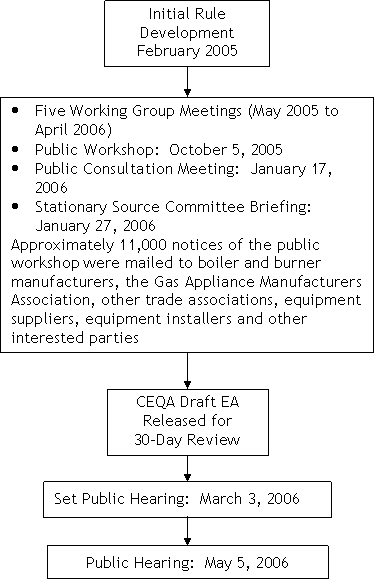
Fourteen (14) months spent in rule development.
ATTACHMENT D
KEY CONTACTS LIST
- Ajax Boiler
- Alzeta
- American Water Heater
- AO Smith
- Bradford White
- California Air Resources Board (CARB)
- COEN
- Ferguson Enterprises
- Fulton Boiler
- Gas Appliance Manufacturers Association, Inc.
- General Installation Company
- Global Equipment Sales
- Heat Technology Products
- Hirsch Pipe & Supply
- Jandy Pool Products
- John Zink / Gordon Piatt
- Lattner Boiler
- Lochinvar
- Maxon Corporation
- Noritz America
- Parker Boiler
- POLIDORO USA
- Power Flame
- PVI
- Raypak
- Rheem
- Rite Boiler
- R.F. MacDonald Co.
- Schott Gas Systems
- Southern California Boiler
- Southern California Gas Company
- USEPA