
BOARD MEETING DATE: May 2, 2008
AGENDA NO. 34
PROPOSAL:
Amend Rule 1149 – Storage Tank and Pipeline Cleaning and Degassing
SYNOPSIS:
The proposed amendments to Rule 1149 - Storage Tank and Pipeline Cleaning Degassing will further reduce VOC emissions by establishing a vapor concentration standard for the cleaning and degassing of storage tanks, extending the applicability of the rule to pipelines and more tanks, streamlining the notification procedure and improving the clarity of the rule. The proposed amendments will also establish a protocol to quantify voluntary reduction efforts of CO2 emissions from the cleaning and degassing of natural gas pipelines.
COMMITTEE:
Stationary Source, March 21, 2008, Reviewed
RECOMMENDED ACTIONS:
Adopt the Resolution:
1. Certifying the CEQA Final Environmental Assessment for Proposed Amended Rule 1149 – Storage Tank and Pipeline Cleaning and Degassing; and
2. Adopting Proposed Amended Rule 1149 – Storage Tank and Pipeline Cleaning and Degassing.
Barry R. Wallerstein, D.Env.
Executive Officer
Background
In 1987, Rule 1149 was adopted to reduce VOC emissions from degassing operations of stationary storage tanks. At the time of adoption, staff estimated that 800 floating roof tanks, 213 fixed roof tanks and 33,600 underground storage tanks (UST) located at petroleum refineries and terminals, chemical plants and gasoline stations would be subject to the rule. Based on each tank being degassed once every ten years, an estimated 0.4 tons per day were expected to be controlled from floating and fixed roof tanks and another 0.3 tons per day were to be controlled from USTs. In 1995 the rule was amended to remove ambiguities in rule language relating to business and regulatory practices.
Since the time of adoption, the number of above-ground storage tanks degassed each year has tripled. The increase has primarily come from product changes that occur when a tank is used to temporarily store a product, such as crude oil or gasoline. When the product is purchased, the entire tank is pumped to the purchaser leaving the tank filled with vapors that require degassing.
California Code of Regulations, Title 8 - General Industry Safety Orders has strict restrictions for entry into confined spaces with hazardous atmospheres such as petroleum storage tanks. In order to avoid the restrictions, some facilities vent the vapors contained in the storage tanks into a control device until the tank interior is no longer considered a hazardous atmosphere and the proposed rule requirements would be met.
Affected Facilities
The facilities subject to this amendment include petroleum refineries and terminals, chemical plants and hazardous material pipelines.
Public Process
During the rulemaking process, staff made eighteen site visits and met twelve times with industry and members of the community. A public workshop and CEQA scoping meeting was held on January 9, 2008.
Proposal
Proposed amendments extend the applicability of the rule to pipelines and to additional above-ground storage tanks (see Table 1).
Table 1 – Proposed Changes to Storage Tank Applicability
| Vapor Pressure | Typical Products | Current (gallons) | Proposed (gallons) |
| 3.9 psia RVP | Gasoline | 19,815 | 500 |
| 2.6 psia RVP | Crude | 39,630 | 26,420 |
| 0.5 psia RVP | Kerosene | N/A | 100,000 |
Further, PAR 1149 establishes a 5,000 ppmv vapor concentration standard for storage tanks and pipelines to meet before opening to atmosphere.
Floating roofs that have landed on their legs or supports will be required to be free of vapors at all points of release, vented to a control device or, as an additional compliance option for drain-dry breakout tanks, be maintained in a vapor tight condition of 500 ppmv measured as methane. A compliance schedule is included for drain-dry breakout tanks that must be modified to meet the compliance option. This will address a common situation and codifies an enforcement policy.
The VOC vapor concentration of a “vapor leak” will be lowered from 10,000 ppmv to 5,000 ppmv. The proposed amendment will also remove the test method from the definition and place it in the Test Methods section. The test method will include directions for distance and/or placement of the probe inlet.
Vacuum trucks that remove product residual and sludge from pipeline and storage tanks subject to the rule will be required to exhaust vapors into a control device. The exhaust concentration of control devices will be limited to 500 ppmv, measured as methane.
Also proposed is to shorten the notification period and duration as well as eliminate the need for authorization. Emergency notification requirements will be removed. The notification procedure will be streamlined requiring between two hours and two days notification before degassing takes place allowing more flexibility to affected sources and improving the accuracy of the notifications.
Some new exemptions will be included in the proposed amended rule. Small diameter pipelines and small lengths of pipeline depending on the vapor pressure of the liquid it previously contained will be exempted. Also exempted from the requirements of the rule are tanks and pipelines when they are opened to connect or disconnect degassing equipment, sample emissions, purging inert gas from pipelines when reintroducing product or to connect or disconnect the pipeline.
Finally, the proposal includes a mechanism for quantifying carbon reductions. The provision in PAR 1149 is voluntary and limited to the control of methane emissions from the degassing of natural gas pipelines, which is exempt from the requirements of the rule. Efforts to limit methane emissions from natural gas pipeline repair and maintenance activities will allow companies to reduce greenhouse gas emissions.
Emission Reductions and Cost Effectiveness Determination
At full implementation, PAR 1149 would achieve approximately 1.27 tons per day of VOC emissions reductions. Theoretically, if the VOC vapors in the storage tanks are completely saturated, PAR 1149 would achieve 1.97 tons per day of VOC emission reductions. The cost effectiveness of the proposed amendments is $13,159 per ton of VOC reduced based on the additional time required to degas storage tanks and pipelines to the proposed vapor concentration standard.
AQMP and Legal Mandates
PAR 1149 will implement Control Measure FUG-04 – Further Emission Reductions from Pipeline and Storage Tank Degassing, of the 2007 Air Quality Management Plan (AQMP) by requiring a vapor concentration standard be met before opening storage tanks and pipelines to atmosphere.
California Environmental Quality Act
Pursuant to California Environmental Quality Act (CEQA) Guidelines §15252 and AQMD Rule 110, the AQMD has prepared an Environmental Assessment (EA) for PAR 1149. The Draft EA was released for a 30-day public review and comment period beginning March 11 and ending April 9, 2008. One comment letter was received from the public and is included with a response to comment in Appendix D of the Final EA
Socioeconomic Analysis
PAR 1149 would affect 72 facilities operating above-ground storage tanks and/or pipelines transporting refined products such as gasoline and crude oil. The affected facilities belong to the sectors of petroleum bulk stations and terminals, petroleum refineries, crude petroleum and natural gas extraction, pipeline transportation of refined petroleum products, other warehousing and storage, petrochemical manufacturing, and pipeline transportation of crude oil.
The average annual cost of PAR 1149 is estimated at $5.2 million between 2008 and 2020. The majority of the cost ($3.80 million) will incur in the industry of petroleum bulk stations and terminals where most of the affected facilities belong. Of the $5.2 million cost, $4.3 million is for the existing tanks, $0.4 million for tanks previously exempt, and $0.5 million for pipeline degassing.
PAR 1149 is projected to have 32 jobs forgone annually in the entire four-county economy between 2008 and 2020 (less than one-hundredth of one percent of the total four-county employment).
Implementation and Resources
No additional AQMD resources are required to implement the proposed amendments.
Attachments
A. Summary of Proposed Amendments
B. Rule Development Process
C. Key Contacts List
D. Resolution
E. Rule Language
F. Final Staff Report
G. Final Socioeconomic Report
H. Final Environmental Assessment
ATTACHMENT A
SUMMARY OF PROPOSED AMENDMENTS
- Vapor Concentration Standard
Remove time and equipment requirements in paragraphs (c)(5) and (c)(6) and replace them with a vapor concentration requirement of 5,000 ppmv, measured as methane. The concentration must be met for at least one hour after degassing has been completed.
- Newly Applicable Storage Tanks and Pipelines
Extend the applicability of the rule to pipelines and to more above-ground storage tanks
- Floating Roof Tank Landings
Require floating roofs that have landed on their legs or supports to be free of vapors, vented to a control device or, as an additional compliance option for drain-dry breakout tanks, be maintained in a vapor tight condition of 500 ppmv measured as methane. A compliance schedule is included for tanks that require modification to utilize the latter option.
- Handling and Disposal of Sludge and Product Residual
Require sludge and product residual removed from tanks and pipelines subject to the rule to be stored or disposed into closed containers or control systems free of liquid and vapor leaks.
- Notifications Procedures
Streamline notification procedures to allow more flexibility to affected sources and improve the accuracy of the notifications.
- Vacuum Trucks
Require vacuum trucks that remove product residual and sludge from pipeline and storage tanks subject to the rule to exhaust vapors into a control device.
- Voluntary Greenhouse Gas Reduction Quantification Protocol
Include a quantification protocol for companies who voluntarily control methane emissions from natural gas pipelines.
ATTACHMENT B
PAR 1149 RULE DEVELOPMENT PROCESS
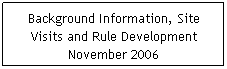

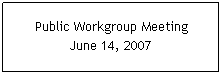
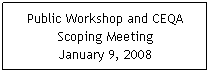
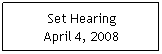

ATTACHMENT C
KEY CONTACTS LIST
BP West Coast Products BP West Coast Terminals
ChevronTexaco Products Co. Chevron Pipeline Company
ConocoPhillips Equilon
ExxonMobil ExxonMobil Pipeline Company
Kinder Morgan Paramount Petroleum
Plains All American Pipeline PSC
Sempra Energy Shell Lubricants
Tesoro United Pumping Service
Valero
Industry Association
Western States Petroleum Association
Degassing Contractors
ABLE Degassing Adams Services
Ancon Marine Envent
GEM International Technologies and Services
JEM Degassing Nieto and Sons
Others
Coalition for Clean Air
Communities for a Better Environment
Office of the State Fire Marshall
RSI-Save
RESOLUTION NO. 2008-xx
A Resolution of the South Coast Air Quality Management District (AQMD) Governing Board certifying the Final Environmental Assessment for Proposed Amended Rule 1149 – Storage Tank and Pipeline Cleaning and Degassing.
A Resolution of the AQMD Governing Board adopting Amended Rule 1149 – Storage Tank and Pipeline Cleaning and Degassing.
WHEREAS, the AQMD Governing Board has determined with certainty that Proposed Amended Rule 1149 – Storage Tank and Pipeline Cleaning and Degassing, is a “project” pursuant to the terms of the California Environmental Quality Act (CEQA); and
WHEREAS, the AQMD has had its regulatory program certified pursuant to Public Resources Code §21080.5 and has conducted CEQA review pursuant to such program (AQMD Rule 110); and
WHEREAS, AQMD staff has prepared a Draft Environmental Assessment (EA) pursuant to its certified regulatory program and CEQA Guidelines §15252 setting forth the potential environmental consequences of Proposed Amended Rule 1149 – Storage Tank and Pipeline Cleaning and Degassing; and
WHEREAS, the Draft EA was circulated for public review, one comment letter was received and the Draft EA has been revised such that it is now a Final EA; and
WHEREAS, it is necessary that the adequacy of the Final EA including response to comments must be determined by the AQMD Governing Board prior to its certification; and
WHEREAS, a Mitigation Monitoring Plan pursuant to Public Resources Code §21081.6, has not been prepared since no mitigation measures are necessary; and
WHEREAS, the AQMD Governing Board voting on Proposed Amended Rule 1149 – Storage Tank and Pipeline Cleaning and Degassing, has reviewed and considered the Final EA prior to its certification; and
WHEREAS, the AQMD Governing Board has determined that the Socioeconomic Impact Assessment of the Proposed Amended Rule 1149 – Storage Tank and Pipeline Cleaning and Degassing, is consistent with the Governing Board March 17, 1989 and October 14, 1994 resolutions and the provisions of Health and Safety Code Sections 40440.8, 40728.5 and 40920.6; and
WHEREAS, the AQMD Governing Board has determined that the Proposed Amended Rule 1149 – Storage Tank and Pipeline Cleaning and Degassing, will result in increased costs to industry, yet is considered cost-effective with a cost-effectiveness as described in the Socioeconomic Impact Assessment and the Final Staff Report; and
WHEREAS, the AQMD Governing Board has actively considered the Socioeconomic Impact Assessment and has made a good faith effort to minimize such impacts; and
WHEREAS, the AQMD Governing Board has reviewed and considered the staff's findings related to cost and employment impacts of the Proposed Amended Rule 1149 – Storage Tank and Pipeline Cleaning and Degassing, set forth in the Socioeconomic Impact Assessment made public with the agenda package for this meeting, and hereby find and determines that cost and employment impacts are as set forth in that assessment; and
WHEREAS, the AQMD Governing Board has determined that a need exists to adopt the Proposed Amended Rule 1149 – Storage Tank and Pipeline Cleaning and Degassing, to reduce VOC from releases at petroleum facilities by implementing Control Measures FUG-04 of the 2007 AQMP and to achieve federal PM2.5 and ozone standards in 2014 and 2024, respectively; and
WHEREAS, the AQMD Governing Board of the South Coast Air Quality Management District obtains its authority to adopt this proposed amended rule referencing to Sections 39002, 40000, 40001, 40440, 40702 and 41508 of the California Health and Safety Code; and
WHEREAS, the AQMD Governing Board has determined that Proposed Amended Rule 1149 – Storage Tank and Pipeline Cleaning and Degassing, as proposed to be adopted is written or displayed so that its meaning can be easily understood by the persons directly affected by it; and
WHEREAS, the AQMD Governing Board has determined that Proposed Amended Rule 1149 – Storage Tank and Pipeline Cleaning and Degassing, as proposed to be adopted is in harmony with, and not in conflict with or contradictory to, existing federal or state statutes, court decisions, or regulations; and
WHEREAS, the AQMD Governing Board has determined that Proposed Amended Rule 1149 – Storage Tank and Pipeline Cleaning and Degassing, as proposed to be adopted does not impose the same requirements as any existing state or federal regulation and the proposed rule is necessary and proper to execute the powers and duties granted to, and imposed upon, the District; and
WHEREAS, the AQMD Governing Board has determined that Proposed Amended Rule 1149 – Storage Tank and Pipeline Cleaning and Degassing, as proposed to be adopted, references the following statutes which the AQMD hereby implements, interprets or makes specific; Health and Safety Code 40001(a) and (b) (air quality standards and air pollution episodes); 40702 (adoption of rules and regulations), and 40440 (rules and regulations to carry out the air quality management plan and to require best available retrofit control technology); and
WHEREAS, the AQMD Governing Board has determined that there is a problem that Proposed Amended Rule 1149 – Storage Tank and Pipeline Cleaning and Degassing, as proposed will alleviate, i.e., the Basin is in nonattainment of the federal ozone and PM2.5 standards, and the proposed amended rule will promote attainment of these standards,
WHEREAS, a public hearing has been properly noticed in accordance with the provisions of Health and Safety Code Section 40725; and
WHEREAS, the AQMD Governing Board has held a public hearing in accordance with all provisions of law; and
WHEREAS, the AQMD Governing Board specifies the manager of Proposed Amended Rule 1149 – Storage Tank and Pipeline Cleaning and Degassing, as the custodian of the documents or other materials which constitute the record of proceedings upon which the adoption of this proposed amendment is based, which are located at the South Coast Air Quality Management District, 21865 Copley Drive, Diamond Bar, California; and
WHEREAS, the AQMD Governing Board finds and determines, taking into consideration the factors in Section (d)(4)(D) of the Governing Board Procedures, that the modifications adopted which have been made to Proposed Amended Rule 1149 – Storage Tank and Pipeline Cleaning and Degassing, since notice of public hearing was published do not significantly change the meaning of the proposed amended rule within the meaning of Health and Safety Code Section 40726 and would not constitute significant new information requiring recirculation of the Draft EA pursuant to CEQA Guidelines Section 15073.5; and
WHEREAS, the AQMD Governing Board has determined that Proposed Amended Rule 1149 – Storage Tank and Pipeline Cleaning and Degassing, should be adopted for the reasons contained in the Final Staff Report, and
NOW, THEREFORE, BE IT RESOLVED, that the AQMD Governing Board hereby determines that the EA is adequate and certifies, pursuant to the authority granted by law, the Final EA for Proposed Amended Rule 1149 – Storage Tank and Pipeline Cleaning and Degassing, and
BE IT FURTHER RESOLVED, that because no significant adverse environmental impacts were identified as a result of implementing Proposed Amended Rule 1149 – Storage Tank and Pipeline Cleaning and Degassing, a findings pursuant to Public Resources Code Section 21031, a Statement of Overriding Considerations pursuant to CEQA Guidelines Section 15093, and a Mitigation Monitoring Plan pursuant to Public Resources Code Section 21031.6 are not required; and
BE IT FURTHER RESOLVED, that the AQMD Governing Board does hereby adopt, pursuant to the authority granted by law, Proposed Amended Rule 1149 – Storage Tank and Pipeline Cleaning and Degassing, as set forth in the attached and incorporated herein by reference.
___________
_____________________________
Date Clerk of the Boards
Attachments (exe 1314 kb)